Nammu21 automates syndicated loans on Google Cloud Universal Ledger with AI
Fintech firm partners with Google to turn legal agreements into smart contracts, targeting faster settlements and reduced friction in private credit markets.
Nammu21 has partnered with Google Cloud to automate the entire lifecycle of syndicated loans using artificial intelligence and a new proof-of-concept on the Google Cloud Universal Ledger (GCUL). By transforming complex legal documents into programmable assets known as Digital Credit Instruments, the collaboration aims to solve long-standing issues such as multi-week settlement times and valuation opacity.
Digitizing the loan market
The syndicated loan and private credit markets rely on manual processes that create significant operational drag and data silos. According to the Loan Market Association, secondary market settlement times for par/near par loans in Q4 2024 averaged 42 days, with a median of 27 days. These slow timelines tie up capital, increase counterparty risk, and impose heavy reconciliation burdens on participants.
Nammu21 addresses this by rendering each facility's governing terms as a Digital Credit Instrument (DCI). This process maps every term—including conditions, consents, eligibility criteria, and operational mechanics—directly back to its originating legal provision. These elements are then expressed as executable behaviors against the loan's live state.
To instantiate these instruments, the proof-of-concept utilizes GCUL, an institutional-grade, permissioned distributed ledger designed for near-instant transaction finality and predictable costs without the volatility or security concerns of public blockchains.
A purpose-built stack for digital credit
Combined with Nammu21's data intelligence, GCUL provides the foundational infrastructure for converting legal document logic into live, programmable contracts. The platform uses gculpy, a strict, statically-typed subset of Python designed to be safe, readable, and auditable.
For regulated financial institutions, gculpy offers distinct operational advantages over other ledger programming models:
- It removes the need for complex memory management or workarounds to meet highly restrictive call stack limits.
- It allows engineers to focus on financial logic rather than technical constraints.
GCUL also provides robust, built-in permissioning that requires explicit user authorization before a contract can store data on their behalf. This solves the "unsolicited asset" problem common on public networks, where unwanted tokens can be sent to an organization's wallet, creating compliance and accounting issues. With GCUL, institutions maintain full control over which assets they interact with.
Nammu21 serves a dual role in this architecture: first rendering the DCI programmatically from the original legal agreement without manual document reading, and then deriving gculpy contracts that define the structure of the obligation using the DCI to supply terms determining what the loan documents permit, require, and block.
Technical architecture: The loan lifecycle on GCUL
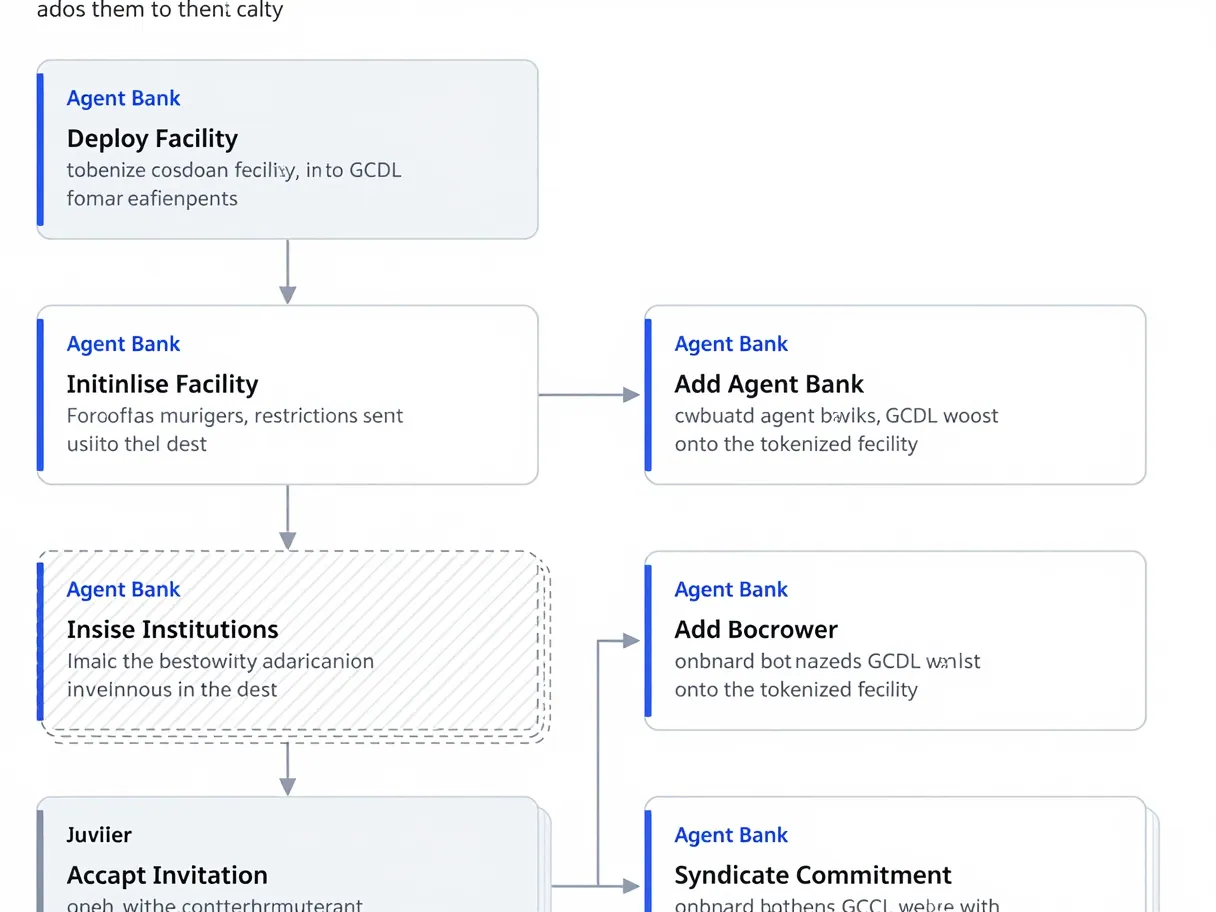
The proof-of-concept modeled a $1.945 billion Term Loan B, where all parties worked off a permissioned view of the same on-ledger rendering. The lifecycle begins when an agent bank selects a specific credit agreement transformed by Nammu21, which instantly provides structured terms to instantiate a unique gculpy contract on GCUL.
Subsequent events are managed as multi-step, automated workflows governed by a consent-driven model:
- Onboarding: Participants review requests and provide explicit consent via their own interfaces before being onboarded.
- Verification: Once all parties are onboarded, the agent bank records an immutable hash of the loan's key terms on-ledger to attest that data matches canonical off-ledger records.
- Transfers and Payments: Actions like secondary market transfers require new lender, borrower, and agent bank consent before execution. All payment flows settle directly on GCUL using tokenized commercial bank money.
Transacting with familiar, regulated money on a programmable ledger is grounded in three core pillars:
- Compliance via gated execution: Contracts validate every action against governing terms transformed from the agreement before execution, mitigating covenant breaches or invalid transfers upfront.
- Role-based privacy: GCUL enforces strict access controls to ensure trading strategies and sensitive loan data remain confidential for necessary counterparties only.
- Settlement finality: Every on-ledger action completes near-instantly and anchors on canonical data derived from the original credit agreement, replacing provisional models with real-time verification.
The business impact of moving on-ledger
This proof-of-concept illustrates a structural shift in how credit markets can operate by rendering governing terms as a DCI and executing them on GCUL. Resolving interpretation issues on-ledger enables settlement times to compress, back-office overhead to shrink, and counterparty risk to be mitigated by design rather than manual checking.
By freeing up capital trapped in lengthy settlement cycles, the architecture unlocks new liquidity and supports a more dynamic secondary loan market. The team would like to thank Someera Khokhar, Jordan Shelley, and Saskia A. Aalders at Nammu21 and Googlers Ishan Singh, Kathryn Stavish, Tom Chudy, and Stathis Onasoglou for their contributions.